Making an LLM Efficient By Optimizing Thinking Time, Not Parameter Count
For a model that must fit on a small device, the parameter budget is fixed. The place to spend is inference-time compute.


For a model that must fit on a small device, the parameter budget is fixed. The place to spend is inference-time compute.
On saturated consumer hardware, you do not buy small-model quality with a faster framework. You buy it with better data and a better training objective, with numbers to back it.
Speculative decoding and multi-token prediction cut byte-level generation latency without touching output quality. Here is what we measured on Veritate's models
Below roughly four bits per weight, post-hoc QAT on byte-level models is catastrophic, and quantization-aware training recovers nearly all of the lost quality
I am convinced the future of useful AI is small, efficient, often task-specific models, not an endless race for the biggest one. Quality per watt beats brute force.
Years of building infrastructure taught me that trust is earned quietly, honesty about limits beats big promises, and locking people in is a slow death.
The instinct in language modeling is to buy quality with parameters. Veritate's working hypothesis is different: for a model that must fit on a consumer or embedded device, the parameter budget is fixed and small, so the place left to spend is inference-time compute. Generate several candidate answers and pick the best; run a short chain of reasoning; verify before committing. The theoretical and empirical literature says this axis is real, and our own small-scale measurements say it shows up even at 85M. This article lays out the argument and the evidence that, for a small model, thinking time is a more honest lever than parameter count.
There is a clean complexity-theory result behind this. Merrill and Sabharwal (ICLR 2024), together with subsequent lower-bound work, show that a transformer allowed a polynomial number of chain-of-thought steps can decide every polynomial-time-solvable problem; with a linear number of steps it can recognize regular languages and simulate counter machines. The consequence is blunt: in the asymptotic sense, parameter count is not the bottleneck for what a model can compute. Thinking time is. A small model with enough serial reasoning steps and a verifier occupies the same complexity class as a large one with the same step budget. That does not make a small model equal to a large one in practice, but it removes the theoretical objection to the entire small-model-plus-inference-compute program.
The empirical literature backs the frame at practical scale. DeepSeek-R1-Distill at 1.5 billion parameters reaches AIME-2024 pass-at-one of 28.9 and MATH-500 of 83.9, and with 64-sample consensus voting its AIME pass rate roughly doubles to 52.7, beating much larger general-purpose models on math specifically. That is test-time compute, majority voting over many samples, converting a small model's single-shot weakness into competitive accuracy. The same paper's distilled family establishes that below roughly 1.5 billion parameters multi-step symbolic ability degrades sharply, which is exactly why our program targets the one-to-two-billion band for the base model and pushes the rest of the capability into the inference-time stack.
We wanted to know whether the test-time-compute effect is merely a large-model phenomenon or whether it already appears at our scale. It appears. On the byte-level 85M, generating sixteen candidates per prompt and selecting the best by the model's own per-byte scoring yielded a 45.3 percent mean relative reduction in cross-entropy versus a single sample, across ten diverse prompts. That is self-grading only, the model judging its own outputs, which is the floor; a trained verifier would do better. The point is that test-time scaling is real even at 85M and even on bytes.
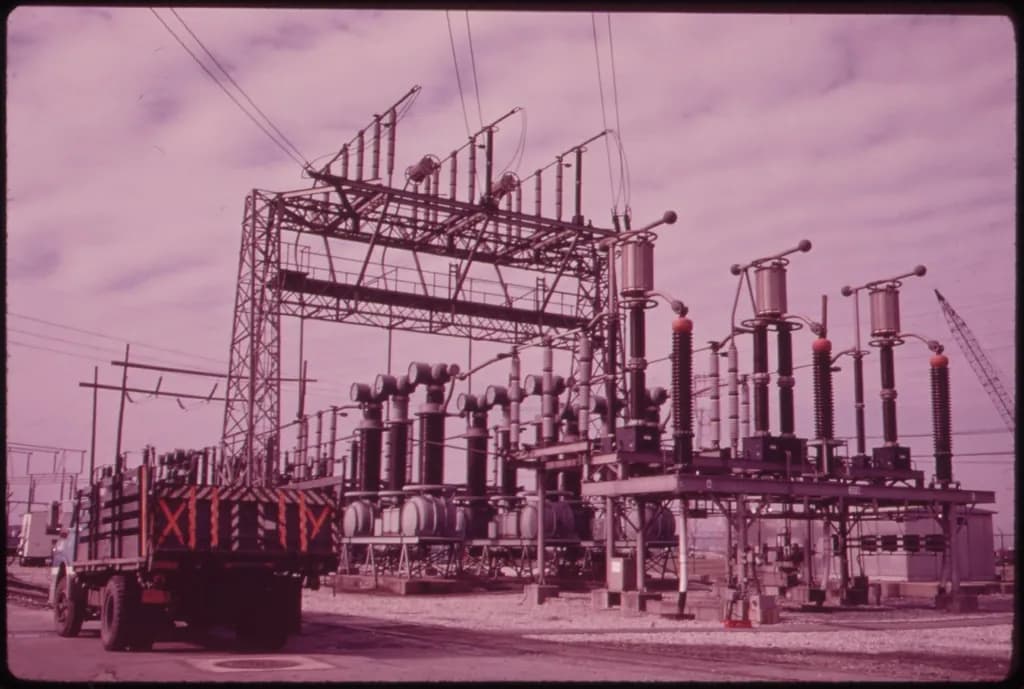
The AI energy cost is treated as an inconsequential while the power demand is at the size of some countries and why efficiency, not scale, is the future.
A second, related finding concerns spending compute adaptively rather than uniformly. A logit-lens early-exit study on the 85M found that about 61 percent of byte positions could commit their prediction by layer seven of twelve, with high-confidence bytes committing by layer six on average and low-confidence ones needing the full depth, projecting roughly 32 percent mean compute savings from a per-position adaptive-depth policy. Confidence is a usable gating signal. This dovetails with the entropy structure reported elsewhere in this series, where the top third of byte positions hold most of the uncertainty: if most bytes are easy, most bytes should get less compute, and the hard minority should get more.
An honest caution from the same line of work: the adaptive-depth saving comes from a trained or calibrated exit signal, not from a naive runtime gate. We tried a pure runtime entropy gate that committed early when the mid-layer prediction looked confident; it fired on under one percent of bytes within our quality budget, roughly thirty times short of target, because mid-layer byte distributions are too diffuse for a low-bar gate. The savings are available, but only through a small trained exit head, not a free runtime trick. This is the same recurring Veritate lesson that appears in our quantization and sparsity work: the win is a training-time investment, not a deployment-time shortcut.
If quality can be bought with serial thinking time and parallel sampling rather than with parameters, then a model that fits in a few hundred megabytes on a five-watt device is not disqualified from competitive behavior on bounded tasks. It is given a knob: spend more wall-clock when the task is hard, spend almost none when it is easy. For an energy-constrained, consumer-hardware target, that knob is worth more than another billion parameters that will not fit.
Our best-of-N and adaptive-depth numbers are at 85M, on a pretrain-only byte model, and the best-of-N result uses self-grading, which is a floor rather than a ceiling; a process-reward verifier remains specified but unbuilt in our work, and we cite the public verifier results as the target rather than as our own. The complexity-theory result is asymptotic and says nothing about constants or about finite-precision practice. The R1 numbers are public results on a subword model, imported as evidence for the frame, not as Veritate measurements. The defensible claim is narrow but solid: test-time compute scaling is measurable at our smallest scale, adaptive per-position compute is available through a small trained signal, and the theory removes the asymptotic objection to trading parameters for thinking time. The same lever runs through related Veritate work, from speculative decoding to byte-level language modeling, where the budget we have is the budget we spend well at inference.
Merrill and Sabharwal, The Expressive Power of Transformers with Chain of Thought, ICLR 2024.
DeepSeek-AI, DeepSeek-R1: Incentivizing Reasoning Capability in LLMs via Reinforcement Learning, 2025.
Snell et al., Scaling LLM Test-Time Compute Optimally can be More Effective than Scaling Model Parameters, 2024.
Elbayad et al., Depth-Adaptive Transformer, 2020.